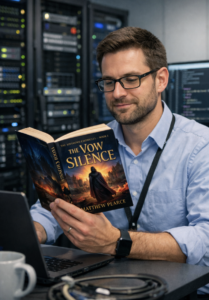
IT professionals spend their days inside systems. They think in dependencies, failure points, permissions, infrastructure, resilience, and risk. They are trained to notice what other people miss, to stay steady when pressure rises, and to keep working through complexity even when the answer is not obvious at first glance. That is exactly why The Sinsworn Chronicles, Book I: The Vow of Silence fits this audience so well. It is not just a fantasy story with action and atmosphere. It is a novel built around discipline, silence, hidden structures, moral pressure, and the cost of carrying responsibility when the stakes keep rising.
For readers who work in technology, fantasy can do more than entertain. It can create a different kind of mental space, one where strategy, loyalty, sacrifice, and worldbuilding matter as much as speed. In that sense, fantasy novels for adults can offer a richer reading experience for people whose professional lives revolve around constant change, nonstop alerts, and the pressure to keep systems running. IT professionals already live in a world where complexity is normal. A strong fantasy novel meets them there, but with heart, imagination, and meaning.
IT Professionals Thrive on Complexity, and This Book Respects That
One reason The Vow of Silence works so well for IT professionals is that it does not feel shallow. The strongest fantasy for adult readers does not rely on surface-level spectacle alone. It builds rules, consequences, tension, and layered decisions. That matters to people in IT because they are rarely satisfied by stories that feel flimsy or careless. They spend their workdays dealing with real structures, whether that means networks, cloud environments, security layers, deployment pipelines, incident response, identity management, or enterprise architecture. Publications such as Computerworld, CIO, and InfoWorld all reflect how broad and demanding that world has become for working technologists.
A book like The Vow of Silence speaks to that mindset because it assumes the reader can handle layered tension. IT professionals are used to seeing that every decision has downstream effects. A small change in one place can create a major consequence somewhere else. In fantasy, that same logic becomes deeply satisfying when the world has internal structure and the characters must operate inside it. The result is not escapism in the empty sense. It is immersion with weight.
That distinction matters. Many professionals in technology are not looking for fluff when they read after work. They want something that lets their minds stay engaged without feeling like another technical manual. They want depth without dashboards. They want intensity without another notification. The Vow of Silence offers that kind of reading experience. It invites the same part of the mind that enjoys solving problems, tracking patterns, and understanding systems, but it places that experience inside a dramatic, imaginative world.
The Themes of Silence, Discipline, and Burden Hit Home for Technical Readers
The title alone, The Vow of Silence, already carries a tone that resonates with IT professionals. In technology roles, especially in operations, security, engineering, and infrastructure, there is often a quiet burden that comes with responsibility. The best people in those roles are not always the loudest people in the room. They are often the ones carrying enormous weight without constant praise. They are the ones who notice the hidden issue, prevent the failure, stay late to solve the incident, and keep the organization moving forward without needing applause.
That quiet pressure feels familiar in today’s IT environment. Coverage from CSO Online shows how security pressure and cyber risk weigh heavily on technology teams, while broader enterprise coverage from Ars Technica’s Biz & IT section and The Register reflects how quickly the landscape keeps shifting around them.
Because of that, a fantasy novel centered on vows, restraint, sacrifice, and duty can connect in a very real way. IT professionals understand what it means to hold the line. They understand what it means to be trusted with things other people barely see. They understand that silence can mean maturity, discipline, and control rather than weakness. Those themes are not abstract to them. They are part of daily work life.
This is one of the biggest reasons the book is a strong fit for the technology audience. It recognizes that strength is not always flashy. In many IT roles, the real work happens quietly. That same energy makes fantasy more powerful when the story values inner resolve as much as outward action. A book built on those values naturally feels aligned with readers who are used to solving hard problems without needing a spotlight.
It Offers a Better Kind of Escape Than Passive Entertainment
Many IT professionals spend the entire day looking at screens, alerts, tickets, logs, dashboards, code, and communication threads. Even when the work is meaningful, the pace can be relentless. Industry coverage continues to focus on AI change, infrastructure shifts, skills pressure, and leadership strain, which tells you a lot about the environment today. CIO has highlighted talent and leadership challenges, while InfoWorld and Computerworld continue covering AI, cloud, software, and enterprise transformation as central parts of the modern IT conversation.
That is exactly why passive entertainment is not always enough. After a demanding day, many professionals do not want more noise. They want a different kind of engagement. They want to step into a story that gives their mind room to breathe while still offering tension, meaning, and stakes. A rich fantasy novel can do that better than doomscrolling, fragmented video content, or another shallow distraction.
The Vow of Silence is well-positioned for that role because fantasy, at its best, gives readers distance from the modern world without removing seriousness. It does not ask them to stop thinking. It asks them to think differently. That matters for technical professionals who may be mentally tired but not mentally empty. They still want substance. They just want it in a form that restores imagination rather than draining it.
This is where the book can become more than entertainment. It can become a reset. It can remind readers what it feels like to enter a world with mystery, structure, danger, and moral consequence. For IT professionals who spend their day in rational systems, that kind of creative immersion is not wasted time. It is a way to refill the part of the mind that works best when it has both logic and vision.
Fantasy and IT Share a Love of Systems, Rules, and Architecture
A surprising number of technology professionals love fantasy for the same reason they love good engineering: well-designed systems are satisfying. In IT, architecture matters. Permissions matter. Dependencies matter. Governance matters. A system that is sloppy eventually fails. A system with structure can scale, adapt, and endure.
The same is true in strong fantasy writing. The world has to make sense. The tensions have to be earned. The rules have to feel real enough that consequences matter. This is one reason fantasy often lands so well with adult readers in technical fields. It rewards attention. It rewards pattern recognition. It respects the reader’s ability to hold multiple layers of reality in mind at once. Even the broad definition of information technology points back to systems for creating, processing, storing, and transmitting information, which is another way of saying that IT professionals are trained to think structurally.
That structural mindset makes a book like The Vow of Silence appealing. It is not simply about events happening one after another. It is about the forces beneath those events. It is about order, pressure, obligation, and consequence. Those are concepts IT professionals understand instinctively.
When a novel is built with care, readers in technical careers can feel it. They notice when a world has integrity. They notice when conflict grows naturally from the design of the world rather than from random chaos. That makes reading more satisfying. It feels closer to discovery than consumption. For a field full of people who spend their lives troubleshooting the hidden layers beneath visible problems, that kind of storytelling is especially rewarding.
It Connects With the Leadership Side of IT, Not Just the Technical Side
Technology work is not only about tools. It is also about trust, communication, judgment, and the burden of decisions. Even highly technical professionals eventually run into leadership challenges. They have to guide teams, manage expectations, navigate pressure, and make choices with incomplete information. That is part of why sources like CIO remain so relevant to the field. The work is never just technical. It is human.
The best fantasy novels understand that truth. They know that power without character means very little. They know that conflict is not interesting unless people must choose what kind of person they will be under pressure. The Vow of Silence can appeal strongly to IT professionals because those readers understand duty in practical terms. They know what it means to carry responsibility that affects others. They know what it means to make decisions where the easy answer is not always the right one.
That is why this book has value beyond genre appeal. It is not only for readers who want swords, danger, and worldbuilding. It is also for readers who appreciate internal conflict, responsibility, and moral seriousness. Those qualities align naturally with a professional audience that deals with risk, trust, and consequence every day.
For many IT professionals, that combination is ideal. They do not want fiction that talks down to them. They want fiction that meets them at an adult level. A story grounded in discipline, loyalty, and the cost of conviction can do exactly that.
Conclusion
The Sinsworn Chronicles, Book I: The Vow of Silence is a great book for IT professionals because it meets them where they actually live. It respects complexity. It values structure. It understands quiet burden. It offers meaningful escape without becoming shallow. It gives adult readers a world with weight, tension, and consequence, which is exactly the kind of storytelling many people in technology appreciate most.
For professionals who spend their days navigating infrastructure, security concerns, leadership pressure, constant change, and mental overload, a strong fantasy novel can feel less like a detour and more like a form of restoration. It keeps the mind engaged while moving it out of the endless churn of modern tech life. That is a real benefit, especially in an industry where the flow of news from places like Computerworld, CSO Online, and The Register’s enterprise coverage never really stops.
That is why this book belongs on the reading list of more technical readers. It is not fantasy that asks them to leave their intelligence behind. It is fantasy that rewards it.
