Technology has a habit of shrinking. Computers once filled rooms. Phones once stayed attached to walls. Data storage that required cabinets can now disappear into a pocket. The same evolution is taking place in practical tools that rarely receive the attention given to smartphones, laptops, or artificial intelligence.
Portable lighting is one of them.
For IT professionals, field technicians, network installers, data center teams, security personnel, emergency responders, and anyone responsible for keeping technology operating outside ideal conditions, dependable lighting can become surprisingly important. A failed circuit, dark server room, nighttime installation, damaged communications cabinet, or power outage can turn a routine job into a difficult one within seconds.
Modern high-performance flashlights reflect many of the same trends shaping the rest of the technology industry: smaller hardware, more efficient electronics, rechargeable power, improved materials, smarter controls, and greater performance from increasingly compact devices. The result is a category of equipment that fits naturally beside the power bank, multitool, laptop, diagnostic equipment, and cables already carried by technology professionals.
Portable Technology Is Becoming Part of the IT Toolkit
The definition of information technology has always extended beyond the desktop computer. Wikipedia’s overview of information technology describes IT as encompassing computers, telecommunications systems, hardware, software, and related equipment used to create, process, store, retrieve, and transmit information. The physical environment supporting those systems matters just as much as the equipment itself.
Servers still need racks. Networks still need cables. Wireless access points need installation. Telecom equipment requires maintenance. Data centers contain electrical systems, cooling infrastructure, power distribution equipment, and thousands of physical connections.
That means IT work frequently leaves the desk.
A network technician may find himself tracing a cable above a suspended ceiling. A systems administrator may need to inspect the rear of a densely packed rack. A field service engineer may arrive at equipment after normal business hours. Telecom technicians may work around roadside enclosures or remote infrastructure where building lighting is nonexistent.
A compact light source can be valuable in all of those situations because it solves a basic problem without adding another large piece of equipment to the bag.
This trend toward powerful technology in smaller packages can be seen throughout the hardware industry. TechCrunch’s hardware coverage regularly follows advances in portable electronics, connected devices, wearables, chips, and consumer hardware. The broader pattern is clear: users increasingly expect professional capability from equipment that travels easily.
Small Hardware Can Deliver Serious Performance
Compact no longer has to mean underpowered.
LED technology helped transform portable lighting by producing substantial illumination without the size, heat, and energy demands associated with older lighting technologies. Manufacturers can combine LEDs with sophisticated electronic controls, rechargeable batteries, multiple operating modes, and durable housings to create tools intended for much more than finding a dropped set of keys.
That engineering progression mirrors developments occurring elsewhere in electronics.
IEEE Spectrum covers advances across computing, consumer electronics, energy, robotics, telecommunications, semiconductors, and engineering. Many of those fields are driven by the same basic goal: accomplish more while reducing the size, weight, or energy requirements of the hardware.
Portable lighting benefits directly from that philosophy.
Instead of carrying a bulky utility light for every job, an IT technician can keep a compact illumination tool in a backpack, vehicle, equipment case, or work belt. It remains available for everyday troubleshooting while also serving as backup equipment when something unexpected happens.
The usefulness becomes especially apparent in locations where technology is packed tightly together. Seeing labels, ports, cable colors, serial numbers, connectors, screws, and equipment status indicators can be difficult even in a properly illuminated server room. Behind a rack or beneath raised flooring, conditions can be considerably darker.
Good illumination is not glamorous, but neither is trying to identify a tiny connection while holding a smartphone over one shoulder.
IT Work Does Not Always Happen in Comfortable Environments
The public image of an IT professional still tends to involve monitors, desks, keyboards, and climate-controlled offices. The reality is much broader.
IT infrastructure exists almost everywhere.
It operates inside warehouses, factories, hospitals, schools, stadiums, retail stores, transportation facilities, utility locations, outdoor communications sites, construction environments, and temporary event spaces. Even ordinary office buildings contain technology in closets, ceilings, utility areas, equipment rooms, and other locations never designed with technician comfort in mind.
Ars Technica has spent decades covering computing, infrastructure, networking, hardware, security, science, and the increasingly complicated systems behind modern technology. One recurring reality across the technology industry is that sophisticated digital services ultimately depend on physical equipment.
When that equipment needs attention, someone has to reach it.
Durable portable gear therefore has a legitimate place in an IT kit. Equipment that can tolerate regular handling, transportation, outdoor conditions, and demanding work environments is particularly useful for employees who move between locations.
Lighting is also one of the rare tools that remains useful regardless of the operating system, network architecture, cloud provider, device brand, or software platform involved.
Power Outages Change the Priorities Immediately
Few events demonstrate the connection between physical infrastructure and IT more clearly than a power failure.
The first concern may be whether servers, switches, communications equipment, security systems, and critical infrastructure remain operational. Uninterruptible power supplies begin carrying loads. Generators may start. Network teams begin checking connectivity. Facilities personnel inspect electrical systems. Employees may need to move through areas where normal building lighting has disappeared.
In those moments, portable illumination stops being a convenience.
Emergency preparedness experts routinely recommend independent lighting for exactly this reason. WIRED’s emergency preparedness guidance includes portable lighting among the useful equipment to have available when normal services are disrupted.
For an IT department, preparedness can extend beyond a flashlight sitting in a building supply cabinet. Technicians responsible for infrastructure can benefit from keeping dependable lighting with the equipment they already grab when responding to an incident.
That becomes even more important when failures occur outside business hours.
A technician responding to a network outage at 2 a.m. may walk into a building with limited staff, partial emergency lighting, and equipment located far from normal work areas. A portable light makes navigation easier and allows inspection to begin without depending on the building’s electrical system.
Rechargeable Technology Has Changed Everyday Carry
Battery technology has helped make portable electronics dramatically more useful. Smartphones, wireless tools, laptops, cameras, drones, power banks, and countless other devices now depend on rechargeable cells.
Flashlights have followed the same path.
Rechargeable designs reduce dependence on disposable batteries while allowing users to restore power between jobs. For professionals who already charge laptops, phones, radios, test equipment, and accessories, adding another rechargeable device to the routine is relatively simple.
Battery quality and charging practices still matter.
The National Institute of Standards and Technology has published research examining lithium-ion battery fire risks, reinforcing the importance of using properly designed equipment and following appropriate charging and storage practices.
For IT departments building field kits, equipment selection should therefore consider more than maximum output. Charging method, battery design, runtime, construction quality, controls, and intended operating environment all deserve attention.
The most useful tool is rarely the one with the biggest specification printed on the box. It is the one that reliably performs when someone actually needs it.
A Practical Addition to Server Room Work
Server rooms present an interesting lighting problem.
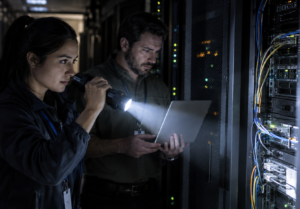
The room itself may be brightly illuminated while the exact location requiring attention remains almost invisible. Equipment faces forward, while many of the cables, power connections, network ports, and mounting points sit at the rear.
Racks create shadows. Bundled cables hide labels. Equipment blocks ceiling lighting. Raised floors create additional dark areas.
A handheld light allows technicians to direct illumination exactly where it is needed without repositioning equipment or relying on a phone.
This sounds like a small advantage until someone has spent twenty minutes tracing one cable through a rack filled with nearly identical connections.
Portable lights can also help when inspecting equipment for physical warning signs. Loose connections, damaged cables, dust accumulation, moisture, blocked ventilation areas, and unexpected debris are easier to notice with concentrated illumination.
For technicians who regularly perform installations or maintenance, the tool quickly moves from emergency equipment to ordinary working equipment.
Field Service Makes Durability More Important
IT work performed outside a permanent office presents another set of challenges.
Field technicians routinely transport equipment in vehicles, backpacks, hard cases, and tool bags. Gear gets bumped, dropped, exposed to dust, carried through rain, and used in spaces where delicate consumer electronics are not ideal.
Rugged construction therefore matters.
The technology world increasingly recognizes the importance of designing equipment around real operating environments rather than laboratory conditions. Portable computing, industrial networking, ruggedized tablets, outdoor wireless equipment, and field diagnostic tools are all examples of hardware built around that principle.
A field-ready lighting tool belongs to the same category.
It can assist with telecommunications installations, outdoor networking equipment, surveillance systems, structured cabling, event technology, audiovisual installations, remote infrastructure, vehicle electronics, and temporary networks.
The benefit is not specialized functionality. It is versatility.
One small device can solve the same fundamental visibility problem across dozens of different technical environments.
Emergency Readiness Is Part of Technology Resilience
Business continuity discussions tend to focus on backups, redundant systems, cybersecurity, cloud infrastructure, communications, and disaster recovery. Those subjects deserve the attention they receive, but real emergencies quickly expose how dependent digital operations remain on the physical world.
The Cybersecurity and Infrastructure Security Agency’s National Emergency Communications Plan emphasizes resilient communications capabilities during incidents and disasters. Maintaining technology during disruptions requires both sophisticated infrastructure and practical preparation.
An emergency technology kit can include items such as charging cables, power banks, spare batteries, adapters, radios, basic hand tools, network testing equipment, first-aid supplies, and independent lighting.
None of those items replaces an organization’s formal disaster recovery strategy. They support the people responsible for carrying it out.
That distinction matters.
Resilience is not created by one product. It comes from eliminating avoidable points of failure and giving personnel the tools necessary to continue working when normal conditions disappear.
Good IT Gear Solves Problems Without Creating New Ones
The best technology tools tend to share a common trait: they disappear into the workflow.
They do not require complicated setup every time they are used. They do not occupy excessive space. They do not require technicians to reorganize an entire equipment bag. They simply remain available until the moment they are needed.
Portable illumination fits that model particularly well.
A compact light can remain in an IT backpack for months while being used for cable work, equipment inspection, nighttime service calls, power failures, parking-lot installations, ceiling access, event setups, and dozens of small tasks that would otherwise require improvisation.
That is why portable lighting deserves more consideration within professional technology circles. It represents the kind of hardware innovation that rarely dominates headlines but consistently improves real-world work.
Conclusion
The modern IT environment reaches far beyond screens and software. It includes server racks, cables, power systems, communications equipment, field installations, remote infrastructure, emergency response procedures, and the professionals responsible for keeping all of those systems functioning.
Portable lighting has evolved alongside the rest of the electronics industry. Better LEDs, rechargeable power, compact designs, improved materials, and stronger performance have turned a basic household object into legitimate technical equipment.
For IT professionals, the value is straightforward. A klarus flashlight can help during routine maintenance, difficult installations, field service, infrastructure inspections, after-hours calls, and unexpected outages. It is small enough to travel with existing gear while remaining useful across an unusually wide range of situations.
The technology industry often celebrates enormous advances in artificial intelligence, computing power, connectivity, and automation. Sometimes innovation is much simpler. Sometimes it is a compact piece of hardware sitting quietly in a technician’s bag, ready to become one of the most useful tools in the room the moment the lights go out.
